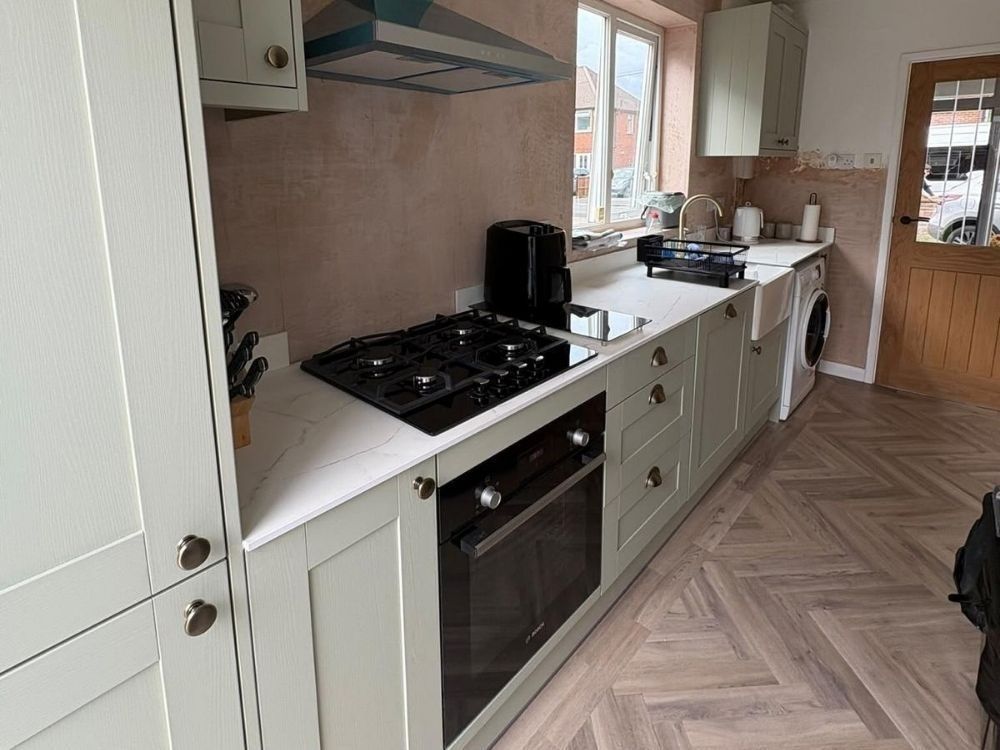
Small Kitchen Design Solutions
If you live in one of Derby's Victorian terraces, a 1930s semi in Littleover, or a modern flat conversion, you'll know the challenge of working with a compact kitchen. Most properties built before 1970 feature kitchens measuring just 2.5m x 3.5m to 3m x 4m – spaces that were designed when kitchens were purely functional rooms, not the social hubs they've become today.
The good news? With thoughtful design and professional installation, even the smallest Derby kitchen can be transformed into a highly functional, attractive space that works considerably harder than your current layout. We've helped hundreds of Derbyshire homeowners increase their kitchen storage by 40-60% whilst creating better workflow, more worktop space, and a lighter, more welcoming feel.
You're not alone in feeling frustrated with limited storage, cramped cooking areas, or that closed-in feeling that comes with outdated layouts. These are the most common complaints we hear from Derby homeowners, and they're all solvable problems. The key lies in understanding which layout works for your specific dimensions, choosing the right storage solutions for your lifestyle, and making smart decisions about appliances, colours and materials.
Whether you're planning a complete renovation or looking to make better use of your existing footprint, this guide shares the professional design principles we apply to every small kitchen project across Derby and Derbyshire. If you'd like to discuss your specific space, call us on 01332 215505 for a free consultation – we'll measure up and talk through realistic options for your home.
Understanding fundamental kitchen layout planning principles helps you make informed decisions for any kitchen size.
SMALL KITCHEN FITTERS NEAR ME
If you live in Derby or further afield in Derbyshire we bring our service to you. So if you are looking for small kitchen fitters near me, we're ideal!
Understanding Your Small Kitchen Layout Options
The layout you choose will fundamentally determine how well your small kitchen functions. There's no single "best" layout – it depends entirely on your room dimensions, where your existing plumbing and drainage sit, the position of windows and doors, and how you actually use your kitchen. As experienced kitchen fitters in Derby, we understand that the layout you choose will fundamentally determine how well your small kitchen functions. Here are the four main configurations we install in Derby's compact kitchens, along with the specific property types and dimensions where each works best.
Single Galley Layout: Best for Narrow Spaces
If your kitchen is under 2.5m wide – typical in many of Derby's terraced properties in areas like Normanton, Chaddesden and the Arboretum – a galley layout is often your most practical option. This design places units along either one or both walls, creating an efficient corridor-style workspace.
The galley layout excels at creating a compact work triangle. In a two-wall galley, you might position your sink and preparation area on one side, with your hob and oven opposite. This means you're never more than a single turn away from any task, which sounds limiting but actually creates remarkably efficient workflow. Every step counts when you're cooking, and galley kitchens eliminate wasted movement.
In Derby's Victorian and Edwardian terraces, we frequently install two-wall galley layouts measuring 2.2m to 2.4m in width with 3m to 3.8m in length. The key to making these work is maintaining at least 1.2m between opposing runs of units – any narrower and you'll struggle when the oven door or dishwasher is open. If your room is particularly narrow (under 2.2m), a single-wall galley with a run of units on one side only may be more practical, though you'll sacrifice some storage capacity.
The advantages are clear: you maximise storage along both walls, create excellent workflow efficiency, and every inch of space is utilised. The trade-off is limited worktop space and the reality that two people working simultaneously can feel cramped. If you're a keen cook who regularly has a sous chef helping in the kitchen, you might find a galley layout frustrating during busy meal preparation.
L-Shaped Layout: Maximising Corner Space
For square or slightly rectangular kitchens – common in 1930s semis throughout Mickleover, Mackworth and Allenton – an L-shaped layout often provides the best balance of storage, worktop space and accessibility. This configuration runs units along two adjacent walls, creating a natural work triangle between your sink, hob and fridge.
The corner in an L-shaped kitchen is simultaneously your biggest asset and your biggest challenge. Specified correctly, corner units can provide substantial storage through pull-out carousel systems (often called "magic corners") or LeMans-style pull-out mechanisms that bring items right to the front. Specified poorly, you end up with a dark, awkward cupboard where Tupperware lids go to die and you need to crouch down and reach to the back to retrieve anything.
This layout works particularly well when you have 2.8m to 3.5m on each wall. It creates a comfortable cooking zone whilst leaving floor space open – often enough room to add a small breakfast bar peninsula or to accommodate a small dining table. Many Derby homeowners choose L-shaped layouts specifically because they want to keep a table in the kitchen for family meals, and this configuration makes that possible without the room feeling overcrowded.
We find L-shaped kitchens are especially effective when one wall contains a window. Positioning your sink beneath the window is a traditional approach that maximises natural light whilst you're preparing food and washing up – something that matters considerably in Derby's north-facing terraced properties where natural light can be limited.
The main consideration with L-shaped layouts is ensuring the two runs are reasonably balanced in length. A heavily lopsided L-shape (say, 4m on one wall and 1.5m on the other) can feel awkward and limit your storage options on the shorter side.
U-Shaped Layout: When You Have Three Walls
If you're fortunate enough to have a slightly larger compact kitchen – typically 10 to 12 square metres – and three walls available without doorways, a U-shaped layout can provide maximum storage and worktop space. We install these configurations regularly in Chellaston and Spondon properties where kitchens are modestly sized but not extremely tight.
The U-shape creates a highly efficient work triangle with everything within easy reach. You'll have worktop space on three sides, meaning you can have dedicated zones for preparation, cooking and cleaning without surfaces becoming cluttered. For people who cook regularly and need elbow room, this layout provides the most functional workspace within a compact footprint.
The risk with U-shaped kitchens is creating a space that feels enclosed and claustrophobic, particularly if you opt for a full run of wall cabinets on all three sides. The solution lies in thoughtful design choices: light-coloured cabinets, potentially using glass-fronted wall units on one side, handleless cabinet doors to reduce visual clutter, and ensuring excellent lighting throughout.
In practical terms, you need at least 2.4m between opposing runs of base units to make a U-shape comfortable. Any tighter and you'll find opening appliance doors becomes awkward, and two people working in the kitchen will be constantly navigating around each other.
Peninsula/Breakfast Bar Addition
Regardless of whether you start with a galley or L-shaped layout, many Derby homeowners add a 600mm to 900mm peninsula to create additional worktop space and subtle room division. This is particularly popular in properties where the kitchen has been opened up to the dining room, creating an open-plan living area whilst maintaining some definition between cooking and eating zones.
A peninsula works as a natural divider without building a wall. The kitchen side provides additional preparation space or can house your hob (with appropriate ventilation), whilst the dining room side serves as a breakfast bar with stools tucked underneath. It's a particularly effective solution for families with children, creating a homework space or casual dining area that keeps everyone together whilst meals are being prepared.
From a practical standpoint, we can integrate storage underneath the breakfast bar – either standard base cabinets on the kitchen side or open shelving on the dining side. If you want to include a sink or dishwasher in the peninsula, this requires careful planning with your plumber to route waste pipes across the floor, which typically means raising floor levels slightly or accommodating pipework beneath flooring.
The peninsula approach is especially valuable in long, narrow kitchens where adding even 600mm of additional worktop perpendicularly creates more usable workspace than extending the linear run would provide.
SPACE-MAXIMISING STORAGE SOLUTIONS FOR SMALL KITCHENS
Once you've determined the right layout for your dimensions, the next priority is
maximising every cubic centimetre of storage potential. Standard kitchen units are designed for average-sized rooms, but small kitchens demand more strategic thinking. These are the storage approaches that deliver the most significant improvements in compact Derby kitchens.
Vertical Storage: Using Every Inch of Height
The single most impactful change you can make in a small kitchen is building upwards. Most kitchens we survey in Derby still have 720mm wall cabinets with a gap above reaching to the ceiling – wasted space that typically accumulates dust and perhaps a few never-used serving platters balanced precariously on top.
Full-height cabinets that run from floor to ceiling immediately reclaim this lost storage. Yes, you'll need a small step stool to access the uppermost shelves, but this is where you store items used occasionally rather than daily: festive tableware, large serving dishes, the slow cooker you use three times a year, spare glassware for entertaining. The items you reach for every day remain at comfortable height in your base units and lower wall cabinets.
There's a secondary benefit beyond pure storage capacity. Full-height cabinets draw the eye upward, making the room feel taller and more spacious rather than squat and closed-in. This visual trick is particularly effective in Derby's older properties where ceiling heights are often generous (2.6m to 2.8m) but floor space is tight.
If full-height cabinets across the entire kitchen feel overwhelming, consider using them strategically – perhaps flanking your cooker or creating a tall larder unit at one end of the run. Even a single full-height unit measuring 300mm or 400mm wide can accommodate an extraordinary amount of dry goods, tins and packets when fitted with internal shelf racks.
Pull-Out and Pull-Down Solutions
The layout you choose will fundamentally determine how well your small kitchen functions. There's no single "best" layout – it depends entirely on your room dimensions, where your existing plumbing and drainage sit, the position of windows and doors, and how you actually use your kitchen. Here are the four main configurations we install in Derby's compact kitchens, along with the specific property types and dimensions where each works best.
Single Galley Layout: Best for Narrow Spaces
If your kitchen is under 2.5m wide – typical in many of Derby's terraced properties in areas like Normanton, Chaddesden and the Arboretum – a galley layout is often your most practical option. This design places units along either one or both walls, creating an efficient corridor-style workspace.
The galley layout excels at creating a compact work triangle. In a two-wall galley, you might position your sink and preparation area on one side, with your hob and oven opposite. This means you're never more than a single turn away from any task, which sounds limiting but actually creates remarkably efficient workflow. Every step counts when you're cooking, and galley kitchens eliminate wasted movement.
In Derby's Victorian and Edwardian terraces, we frequently install two-wall galley layouts measuring 2.2m to 2.4m in width with 3m to 3.8m in length. The key to making these work is maintaining at least 1.2m between opposing runs of units – any narrower and you'll struggle when the oven door or dishwasher is open. If your room is particularly narrow (under 2.2m), a single-wall galley with a run of units on one side only may be more practical, though you'll sacrifice some storage capacity.
The advantages are clear: you maximise storage along both walls, create excellent workflow efficiency, and every inch of space is utilised. The trade-off is limited worktop space and the reality that two people working simultaneously can feel cramped. If you're a keen cook who regularly has a sous chef helping in the kitchen, you might find a galley layout frustrating during busy meal preparation.
Integrated and Hidden Appliances
Integrated appliances serve two purposes in small kitchens: they maximise usable space by fitting precisely into standard cabinet dimensions, and they create clean, uncluttered sightlines by hiding behind cabinet doors.
Slimline dishwashers measuring 450mm wide rather than the standard 600mm save 150mm of base unit width – enough to add another drawer unit for utensils and cutlery. For a household of two to three people, a slimline dishwasher with nine place settings is perfectly adequate. That 150mm you've reclaimed might not sound dramatic, but in a 2.5m kitchen run, it represents 6% more storage or worktop space.
Integrated fridge-freezers maintain the clean lines of your cabinetry rather than having a stainless steel appliance dominating the visual space. This makes the kitchen feel more furniture-like and less utilitarian. You can also find slimline integrated models at 545mm depth rather than 600mm, gaining you 55mm of floor space – particularly valuable in tight galley layouts where every centimetre of width matters.
Combination appliances save space by serving multiple functions in a single unit. A combination microwave-oven-grill can replace a separate microwave sitting on the worktop and provide oven functionality in a single 600mm housing. For smaller households who don't need a large conventional oven, this approach frees up valuable worktop space whilst providing all the cooking functions you actually use.
Built-under ovens represent another space-saving opportunity. Instead of a traditional 600mm eye-level oven housing (which takes up considerable wall space), a built-under single oven fits beneath your worktop, leaving the wall space free for additional storage cabinets.
Creative Storage Ideas
Beyond the major structural storage decisions, numerous smaller innovations can dramatically improve functionality in compact kitchens.
Plinth drawers (also called toe-kick drawers) utilise the 150mm space beneath your base units. This area is normally just a recessed plinth for aesthetic purposes, but it can be converted into slim drawers perfect for storing baking trays, chopping boards, cooling racks and other flat items that are awkward to store elsewhere.
Magnetic knife strips mounted on the wall keep knives organised, easily accessible and safely stored without taking up drawer space. Similarly, wall-mounted rails with S-hooks can hold utensils, small pans and frequently used tools, keeping your worktop clear whilst maintaining everything within arm's reach.
Open shelving divides opinion, but used thoughtfully it can work well in small kitchens. A single run of open shelves creates visual depth and makes the space feel less enclosed than solid wall cabinets. The key is discipline – open shelves look attractive when displaying matching containers, cookbooks or attractive crockery, but become visual clutter quickly if they become a dumping ground for mismatched items.
Internal drawer organisers transform chaotic drawers into meticulously organised storage. Cutlery trays, utensil dividers, and adjustable drawer inserts mean every spoon, spatula and peeler has its designated place. You'd be surprised how much more you can fit into a drawer when items are organised vertically in dividers rather than thrown in loose.
Case Study: Pear Tree Estate Victorian Terrace Kitchen Transformation
Original kitchen: 2.4m x 3.2m (7.68 sq metres), outdated 1990s units with laminate worktops, standard wall cabinets with wasted soffit space above, awkward corner cupboard storing very little effectively, no drawer storage (all door-fronted cupboards), appliances sitting on worktop reducing preparation space.
Our solution: L-shaped layout with full-height corner larder unit (600mm wide x 2400mm high) replacing awkward corner cupboard, four deep pan drawers in base units replacing traditional cupboards, slimline 450mm integrated dishwasher, integrated fridge-freezer, wall cabinets extended to ceiling height, under-cabinet LED lighting, pull-out waste bin and cleaning product storage under sink.
Result: 45% increase in usable storage capacity measured by accessible cubic metres, improved workflow with better work triangle, light and contemporary feel with white handleless cabinets and quartz worktop, worktop entirely clear of appliances.
Budget: £11,500 including Howdens white gloss handleless units, quartz worktop, slimline Bosch integrated appliances, full installation by our team with plumbing and electrical work coordinated through Derbyshire Specialists Group.
Timeline: Seven days from first removal of old kitchen to final completion and handover.
DESIGN TRICKS TO MAKE SMALL KITCHENS FEEL BIGGER
Storage capacity matters, but so does how your kitchen feels. A well-designed small kitchen should feel light, open and welcoming rather than cramped and claustrophobic. These design strategies create the perception of space even when the actual square meterage hasn't changed.
Colour and Light: The Foundation of Space Perception
Light colours reflect light rather than absorbing it, which is why white, light grey and soft cream cabinets remain overwhelmingly popular in compact kitchens. This isn't just aesthetic preference – it's physics. A white kitchen reflects approximately 80% of light back into the room, whilst a dark navy or charcoal kitchen absorbs 70-80% of light, making the space feel significantly smaller.
That said, all-white kitchens can feel sterile and clinical if not balanced carefully. Two-tone kitchens have become increasingly popular for good reason: light-coloured wall cabinets keep the upper portion of the room bright and open, whilst slightly darker base units (perhaps light grey or sage green) provide visual grounding without overwhelming the space. This approach works particularly well in Derby's Victorian terraces where ceiling heights are good but floor space is limited.
Handleless cabinets reduce visual clutter considerably. Traditional handles create small shadows and visual interruptions across your cabinet runs. J-pull handles (where the top edge of the door is routed to create a grip) or push-to-open mechanisms create seamless, unbroken surfaces that read as calmer and more spacious.
One Derby-specific consideration: if your kitchen faces north (common in terraced properties where kitchens back onto yards), you'll have cooler, bluer natural light. Warm-toned whites and creams balance this better than stark brilliant whites, which can feel cold and uninviting in north-facing rooms. Conversely, if you're fortunate enough to have a south-facing kitchen with generous natural light, you have more flexibility with colour choices.
Worktop and Splashback Strategies
Your worktop and splashback choices significantly impact perceived space. Large-format materials with minimal seams or grout lines create visual continuity rather than fragmenting the space into smaller sections.
For splashbacks, large tiles (600mm x 300mm or larger) require fewer grout lines than traditional smaller tiles. Even better, consider glass splashbacks, which create a completely seamless, reflective surface. Glass reflects light back into the room whilst being supremely practical – a simple wipe removes cooking splashes without scrubbing grout lines. We install glass splashbacks regularly in compact Derby kitchens, particularly behind hobs where they create a striking, contemporary focal point.
Continuing your worktop material onto a breakfast bar or windowsill creates visual flow rather than abrupt material changes. This makes the space read as unified and coherent rather than chopped into separate zones. If budget allows, a continuous run of quartz or granite worktop flowing from preparation area through to breakfast bar creates a sophisticated, spacious feel.
Avoid busy patterns or high-contrast materials that draw the eye and break up sightlines. A speckled granite with multiple colours, for instance, creates visual noise that makes a small kitchen feel cluttered before you've placed a single item on the worktop. Subtle, tonal materials in light colours keep the space feeling calm and open.
Lighting Design for Small Spaces
Poor lighting makes any kitchen feel smaller, but it's particularly detrimental in compact spaces. A single central ceiling light – still present in many Derby kitchens we survey – creates harsh shadows and leaves your worktop in darkness when you're standing at it preparing food.
Layered lighting transforms how a kitchen feels and functions. Start with good ambient ceiling lighting (LED panels or recessed downlights provide even, shadow-free illumination). Add task lighting under wall cabinets – LED strip lights illuminate your worktop precisely where you need light for food preparation. Finally, consider feature or accent lighting: perhaps LED strips at plinth level (creates the illusion that cabinets are floating), inside glass-fronted cabinets, or a statement pendant light over a breakfast bar if you have one.
Under-cabinet lighting deserves particular emphasis because it makes your worktop feel more spacious. When your preparation surface is well-lit and shadows are eliminated, the workspace feels larger and more functional. We typically install warm white LED strips (3000K colour temperature) which create welcoming illumination without the clinical feel of cooler white LEDs.
From a practical standpoint, discuss lighting requirements with your electrician early in the planning process. You'll need adequate circuits and switches positioned conveniently – ideally, separate switching for ambient, task and feature lighting so you can adjust according to time of day and activity.
Flooring and Sightlines
The direction you lay flooring materials influences perceived space. Running planks or tiles lengthways (down the longest dimension of the room) extends the eye and makes the space feel longer. Conversely, running them across the width can make a narrow room feel even narrower.
Large-format tiles (600mm x 600mm or larger) reduce grout lines and create a more unified floor surface compared to smaller tiles. Fewer grout lines mean less visual interruption, which helps the floor read as a single plane rather than a busy patchwork.
If your kitchen opens into an adjacent room (dining room or living area), continuing the same flooring material through both spaces makes both rooms feel larger. Your eye travels uninterrupted from one space to the next rather than stopping at a material change, which psychologically makes each area feel more spacious. This approach is particularly effective in Derby properties where kitchens have been opened up to create open-plan living areas.
Light-coloured flooring reflects light upward, bouncing it off walls and ceilings to brighten the entire space. Pale oak-effect LVT, light grey porcelain tiles, or stone-effect flooring in cream tones all achieve this effect whilst remaining practical and durable for kitchen use.
APPLIANCE SELECTION FOR COMPACT KITCHENS
The appliances you choose can make or break a small kitchen design. Oversized appliances consume disproportionate space, whilst thoughtfully selected compact models provide all the functionality you need without dominating the room.
Slimline and Compact Appliance Options
Understanding the dimensional differences between standard and compact appliances helps you make informed decisions about where you can reclaim space.
Dishwashers are available in both 600mm and 450mm widths. A slimline 450mm dishwasher holds nine place settings – perfectly adequate for two to three people and most couples who cook regularly. That 150mm you save can accommodate an additional drawer unit for utensils, cutlery organisers and small kitchen tools. If you're a family of four or five who generates substantial washing-up, the standard 600mm model (twelve to fourteen place settings) may be necessary, but many Derby households overestimate their dishwasher needs.
Fridge-freezers present similar choices. Standard integrated models measure 600mm wide, but slimline versions at 545mm width save 55mm – which sounds modest until you're working with a 2.4m wide galley kitchen where every centimetre matters. Capacity reduces slightly, but for most households, a well-organized slimline fridge-freezer holds everything you need without buying in bulk.
Oven choices significantly impact both space and functionality. A traditional double oven in a 600mm housing takes up considerable wall space with its eye-level positioning. Many compact kitchens function perfectly well with a single built-under oven positioned beneath the worktop, freeing up the wall space for additional storage cabinets. For smaller households, a combination microwave-oven-grill unit provides all cooking functions in a single 600mm housing, eliminating the need for a separate microwave on your worktop.
Hobs warrant consideration too. Do you genuinely use all five burners on a 700mm hob, or would a well-configured four-burner 600mm hob serve your actual cooking patterns? That extra 100mm might accommodate a pan drawer or narrow pull-out spice rack.
Must-Have vs Nice-to-Have Appliances
Honest assessment of your cooking habits prevents space-wasting investments in appliances that gather dust.
Essential appliances for most households include: oven, hob, fridge-freezer, and increasingly, dishwasher (which many now consider essential rather than luxury). Beyond these fundamentals, evaluate carefully.
If you're daily scratch cookers who prepare meals from fresh ingredients every evening, you need substantial hob space, oven capacity and fridge storage. Your appliance budget should prioritize cooking functionality. Conversely, if your household relies more heavily on convenience foods and batch-cooking at weekends, you might prioritize freezer capacity over hob size.
Built-in coffee machines, warming drawers, and wine coolers represent nice-to-have appliances that consume valuable space. In a spacious kitchen, they're wonderful additions. In a compact Derby terrace kitchen measuring 2.5m x 3.5m, that 600mm housing occupied by a wine cooler might be better utilized as storage for everyday crockery and glassware. Be ruthlessly practical about your actual usage patterns rather than aspirational cooking habits.
The same logic applies to small appliances. That bread maker, juicer, food processor and stand mixer might each be used occasionally, but together they consume 1.5 metres of worktop space or fill valuable cupboards. Identify which appliances you genuinely use weekly and find permanent homes for those; consider storing or rehoming the rest.
Appliance Positioning for Workflow
The classic work triangle – positioning your sink, hob and fridge to create an efficient triangle with sides measuring between 1.2m and 2.7m – remains the foundation of good kitchen design. This arrangement minimizes wasted movement during cooking: collect ingredients from fridge, prepare at sink area, cook at hob, all within a few steps.
Common positioning mistakes create frustration. Placing your fridge immediately next to your oven means the fridge's compressor works harder fighting the heat from cooking, increasing running costs and reducing the fridge's lifespan. Leave at least 150mm gap between these appliances, or ideally separate them with a run of base units.
Dishwasher placement benefits from proximity to your sink. This simplifies plumbing connections (both feed and waste pipes run to the same area) and makes practical sense – rinsing plates at the sink before loading them into an adjacent dishwasher creates logical workflow.
In Derby's Victorian and Edwardian properties, existing waste pipe locations sometimes constrain layout possibilities. Most terraced houses have the original waste pipe exiting through the rear wall near where the sink has always been positioned. Moving your sink to a different wall requires routing new waste pipes – entirely feasible, but it adds cost and may require raising floor levels to accommodate the necessary fall for drainage. We discuss these constraints during initial consultation so your design remains grounded in practical reality rather than expensive reconfiguration.
SMALL KITCHEN SPECIALISTS NEAR ME
If you live in Derby or further afield in Derbyshire we bring our service to you. So if you are looking for a small kitchen specialists near me, we're ideal!
SMALL KITCHEN RENOVATION: WHAT TO EXPECT IN DERBY
Understanding the renovation process helps you plan realistically and reduces the anxiety that comes with major home improvements. Here's what actually happens from initial conversation through to your completed kitchen.
Planning and Measurement
Every successful kitchen project begins with accurate measurement and honest conversation about how you use your space. We offer free in-home consultations where we'll measure your kitchen precisely, note the positions of existing plumbing and electrical points, identify any quirks in the property (uneven floors, walls out of square, unusual ceiling heights), and discuss your cooking habits, storage frustrations and budget parameters.
This initial visit typically takes forty-five minutes to an hour. We're looking at dimensions, yes, but also at how natural light enters the room, where you currently store everyday items, which appliances you use frequently, and what aspects of your current kitchen cause daily frustration. These observations inform design recommendations that work for your specific circumstances rather than generic solutions.
If you're purchasing units from Howdens (which we work with regularly), they can provide 3D design renderings showing exactly how your new kitchen will look. These visualizations help you understand the space before commitment, experiment with different door styles or colours, and identify any practical issues with the proposed layout. We find most Derby homeowners appreciate seeing a visual representation – it removes uncertainty about whether that corner solution will actually work or if the breakfast bar will obstruct the doorway.
Budget discussion happens early and honestly. We'll talk through where money is best invested (quality drawer mechanisms and hinges that survive daily use for fifteen years), where mid-range options perform perfectly well (many worktop materials), and where you might save without compromising quality (perhaps starting with budget appliances that can be upgraded in three or four years). This transparency means your final quotation contains no surprises.
Working with Your Property's Constraints
Derby's housing stock spans 150 years of building practices, and each era presents particular challenges that require different approaches.
Victorian and Edwardian properties feature solid walls that are rarely perfectly straight or square. We expect and accommodate this – it's not poor building, it's hand-built walls settling over a century. When fitting modern kitchen units with precise tolerances into these characterful properties, we use scribing techniques and careful levelling to ensure units sit flush despite wall irregularities. Your eye notices a 5mm gap between worktop and wall; skilled fitting eliminates these gaps through patient scribing work.
Floor levels in older properties often slope gently (you might not notice until we set a spirit level down). Modern kitchen units require level installation for doors to hang correctly and drawers to open smoothly. We address this through careful shimming and adjustment during installation – the units themselves are perfectly level even if the floor beneath slopes slightly.
Chimney breasts present both challenges and opportunities. In properties where the kitchen fireplace was removed decades ago, you're left with an alcove that disrupts a clean run of units. We can either integrate this (perhaps with open shelving or a freestanding piece of furniture that suits the proportions), or if you prefer, arrange for the breast to be removed by a builder to create a flush wall. The latter requires structural engineer approval and building control notification, but transforms the space.
If you're considering knocking through to create an open-plan kitchen-dining area, this requires structural calculations, steel beam installation, and building regulations approval. We can coordinate this work through builders within the Derbyshire Specialists Group network, managing the sequence of structural work first, followed by kitchen installation into your newly configured space. This single point of contact simplifies what would otherwise be you coordinating multiple trades across several weeks.
Building regulations apply when you alter electrical circuits, gas supply lines, or undertake structural modifications. Your electrician must notify building control of new circuits. Gas work requires a Gas Safe registered engineer. Removing walls requires structural calculations. We guide you through these requirements and ensure all necessary certifications are obtained.
Living Without Your Kitchen
The honest reality is that for five to seven days, you'll have limited or no kitchen facilities. Planning ahead makes this manageable rather than miserable.
Day one involves removing your existing kitchen – units, appliances and worktops are stripped out, revealing the bare walls and floor. If walls need replastering or floors require levelling, this happens on day two. Days three and four typically involve fitting base units, ensuring everything is perfectly level and secure, and first-fix work by electrician and plumber (running cables and pipes to where appliances will sit).
Days five and six cover worktop templating and installation (if using stone or quartz, this is done offsite then fitted), wall unit installation, and appliance installation. Day seven handles finishing touches – splashback installation, fitting of handles if your design includes them, plinth installation, and final snagging to ensure every door opens correctly and every drawer runs smoothly.
During this period, you'll need temporary arrangements. Many Derby families set up a basic temporary kitchen in their dining room or utility room – kettle for hot water, microwave for heating food, and perhaps a camping stove for very basic cooking. Batch cooking and freezing meals beforehand helps considerably. Some families treat it as an opportunity for takeaway meals or eating out more frequently.
The critical point to understand is that plumbing and electrical work must be completed before final installation. We coordinate closely with electricians and plumbers (either your chosen contractors or those from our Derbyshire Specialists Group network) to ensure they complete their work at precisely the right stage. Poor coordination – for instance, trying to install electrics after worktops are down – creates delays and frustration.
Budget Considerations for Small Kitchen Renovations
Kitchen renovation costs in Derby vary considerably based on specification, but here are realistic ranges based on projects we complete regularly.
Budget range (£6,000-£8,000): Basic units in white or light wood effect, laminate worktops, budget appliances, vinyl flooring. This provides a perfectly functional, clean kitchen that represents dramatic improvement over a tired 1980s or 1990s setup. Installation typically represents £1,200-£1,500 of this total.
Mid-range (£9,000-£14,000): Quality units such as Howdens ranges in various finishes, quartz or granite worktop, mid-range integrated appliances (Bosch, Neff, AEG), either tiled or glass splashback, good quality vinyl or tile flooring. This bracket represents our most common specification for Derby small kitchens – substantial quality upgrade without entering premium pricing. Installation and labour typically £2,000-£2,800.
Premium range (£15,000-£22,000): High-end units with soft-close mechanisms throughout, premium appliances (Miele, Siemens high-end ranges), stone worktops with more elaborate edge profiles, feature lighting, quality tiled flooring. Installation and associated trades work typically £3,500-£4,500.
These figures include everything: units, worktops, appliances, installation labour, and basic plumbing and electrical work (repositioning existing outlets rather than complete rewiring). They don't include major structural alterations, extensive electrical rewiring, or moving waste pipes to different walls.
Understanding where not to cut corners saves money long-term. Quality hinges and drawer runners might add £300-£400 to unit costs but mean drawers still glide smoothly after twelve years of daily use. Budget mechanisms start failing within three to four years, requiring replacement or causing daily frustration. Similarly, quartz worktops cost approximately £800-£1,200 more than laminate in a small kitchen, but they last decades, never need resealing, resist stains and heat, and look substantially better throughout their life.
Conversely, appliances can sensibly be phased. If budget is tight, start with mid-range appliances and upgrade to premium models in four or five years when the originals need replacing anyway. The installation cost is identical whether you fit a £400 dishwasher or a £900 one – the quality difference lies in noise levels, energy efficiency and longevity rather than basic functionality.
For more information about our complete kitchen fitting service and what's included, visit our main kitchen fitters Derby page.
WHY CHOOSE DERBYSHIRE JOINERY SPECIALISTS FOR YOUR SMALL KITCHEN
We've fitted hundreds of compact kitchens across Derby and Derbyshire over the years, which means we understand the particular challenges of working with Victorian terraces in Normanton, 1930s semis in Littleover, and modern conversions in the city centre. This isn't generic kitchen fitting – it's working with properties where walls aren't square, floors aren't level, and every installation requires problem-solving skills developed through experience.
As joiners in Derby first and kitchen fitters second, our carpentry skills matter when precision fitting is required. We can scribe worktops to irregular walls, adjust units to accommodate sloping floors, and create custom solutions when standard specifications don't quite work. This trade-level expertise shows in the finished result – doors that hang perfectly, drawers that glide smoothly, and joins that remain tight even as the house settles and moves through seasonal changes.
Being part of Derbyshire Specialists Group means you deal with one company for your entire renovation. We coordinate electricians, plumbers, tilers and flooring specialists – all trusted trade partners working to the same standards. You're not juggling five different companies' schedules or mediating between trades when sequencing matters. We manage the project timeline so your electrician arrives precisely when first-fix work is needed, your plumber connects appliances when units are positioned, and your tiler completes splashback work before final installation.
Our flexible approach distinguishes us from kitchen companies who insist on supply-and-fit packages. If you've already purchased units from Howdens, Wren, B&Q or any other supplier and need professional installation, we provide competitive fitting-only quotations. Equally, if you want us to handle everything from design consultation through to supplier liaison and complete installation, we do that too. This flexibility means you control budget allocation rather than being locked into predetermined packages.
We provide honest design consultation rather than pushing premium specifications you don't need. If your budget is £8,000 and you're torn between better units or better appliances, we'll explain the long-term implications of each choice so you make informed decisions. If your proposed layout won't work practically in your specific space, we'll tell you early rather than discovering problems during installation.
Geographic coverage spans Derby city and surrounding Derbyshire towns – from Belper to Ashbourne, Ripley to Melbourne. We understand local property stock, typical dimensions in different areas, and common challenges that arise in properties built during different eras.
SMALL FITTED KITCHENS NEAR ME
If you live in or around Derby and are looking for small fitted kitchens near me get in touch today to arrange a quote for us to fit your perfect kitchen
Our Small Kitchen Fitting Process
Every project follows a structured sequence that minimizes disruption and delivers quality results:
1. Free consultation and measure-up: We visit your property, take precise measurements, discuss your requirements and frustrations with the existing layout, and explain what's realistically achievable within your space and budget. No obligation, no pressure.
2. Design discussion and layout options: We present different layout configurations with pros and cons for each approach. If using Howdens units, we arrange 3D visualizations. We discuss appliance choices, storage solutions, and material selections.
3. Transparent quotation: You receive itemized pricing showing exactly what you're paying for – units, worktops, appliances, installation labour, additional trades work. No hidden costs, no unexpected extras.
4. Coordinated scheduling: We book your installation slot and coordinate any necessary trade partners. You know precisely when work begins, which trades arrive on which days, and when you'll have your completed kitchen.
5. Professional installation and finishing: Our fitting team installs to exacting standards – units level, doors aligned, worktops scribed to walls, appliances integrated correctly. We complete snagging checks before handover.
6. Clean, useable kitchen in 5-7 days: From removing your old kitchen to handing over keys to your new space, most compact kitchen installations complete within one working week.
Small Kitchen Design FAQs
Transform Your Small Derby Kitchen Today
Living with a cramped, poorly designed kitchen is frustrating. You've adapted to limited worktop space, inefficient storage, and that closed-in feeling for long enough. The good news is that your compact kitchen holds far more potential than you might imagine – we've proven this hundreds of times across Derby and Derbyshire.
Whether you're at the early stages of thinking about a renovation or you've already purchased units and need professional installation, we'd welcome the opportunity to discuss your specific space. Every kitchen presents unique challenges and opportunities, and honest conversation about what's realistically achievable within your budget and dimensions is where every successful project begins.
Call us on 01332 215505 for a free, no-obligation consultation. We'll visit your property, take accurate measurements, discuss your frustrations with the current layout, and explain what transformations are possible. There's no pressure, no pushy sales approach – just professional advice from experienced joiners who've fitted more small Derby kitchens than we can count.
Not sure if your kitchen is small enough to benefit from these solutions, or too small to improve meaningfully? Call us anyway. We've genuinely seen everything Derby's housing stock can present, and we'll provide honest, practical advice even if that means confirming your current layout is already optimized. You'll know where you stand, which is valuable information in itself.
Derbyshire Joinery Specialists – Kitchen fitting expertise across Derby and Derbyshire since 2008. We serve homeowners throughout Derby and Derbyshire, including kitchen installations in Ilkeston, Allestree and Alfreton.
Derbyshire Joinery Specialists covers:
Kitchen Fitters Derby
, Kitchen Fitters Belper
, Kitchen Fitters Ilkeston
, Kitchen Fitters Heanor
, Kitchen Fitters Ashbourne
, Kitchen Fitters Ripley
, Kitchen Fitters Borrowash
, Kitchen Fitters Castle Donington
, Kitchen Fitters Melbourne
, Kitchen Fitters Alfreton
, Kitchen Fitters Somercotes
, Kitchen Fitters South Normanton
, Kitchen Fitters Allestree
, Kitchen Fitters Quarndon
, Kitchen Fitters Chesterfield
,