
Media walls · Derby
Media Walls Derby
Bespoke media walls, built-in media units and stud partition walls, framed and built by our joiners for homes across Derby and Derbyshire.

- 4.6 from 9 Google reviews
- 10+ years in property & joinery
- Free written quotes
Bespoke media walls in Derby
A media wall turns the television, the fire and all the cables that go with them into one planned piece of joinery. Most are built as a false chimney breast or a full-width wall in timber studwork, boarded and plastered, with recesses sized for the TV, the fire, speakers and shelves, and the wiring hidden inside.
Because the frame is built in the room, everything can be sized to suit it: how far the wall comes out, the height of the screen from your seat, the width of the fire, and how much storage goes either side. No two are the same, so we price each one after seeing the room.
Media wall and stud wall work we do
Most media wall and partition jobs include more than one of these.
- Media walls with fires
- TV walls with hidden cabling
- Slatted panel walls
- Built-in shelving & media units
- Stud partition walls
- Acoustic walls
Our work
How one of our media walls went up
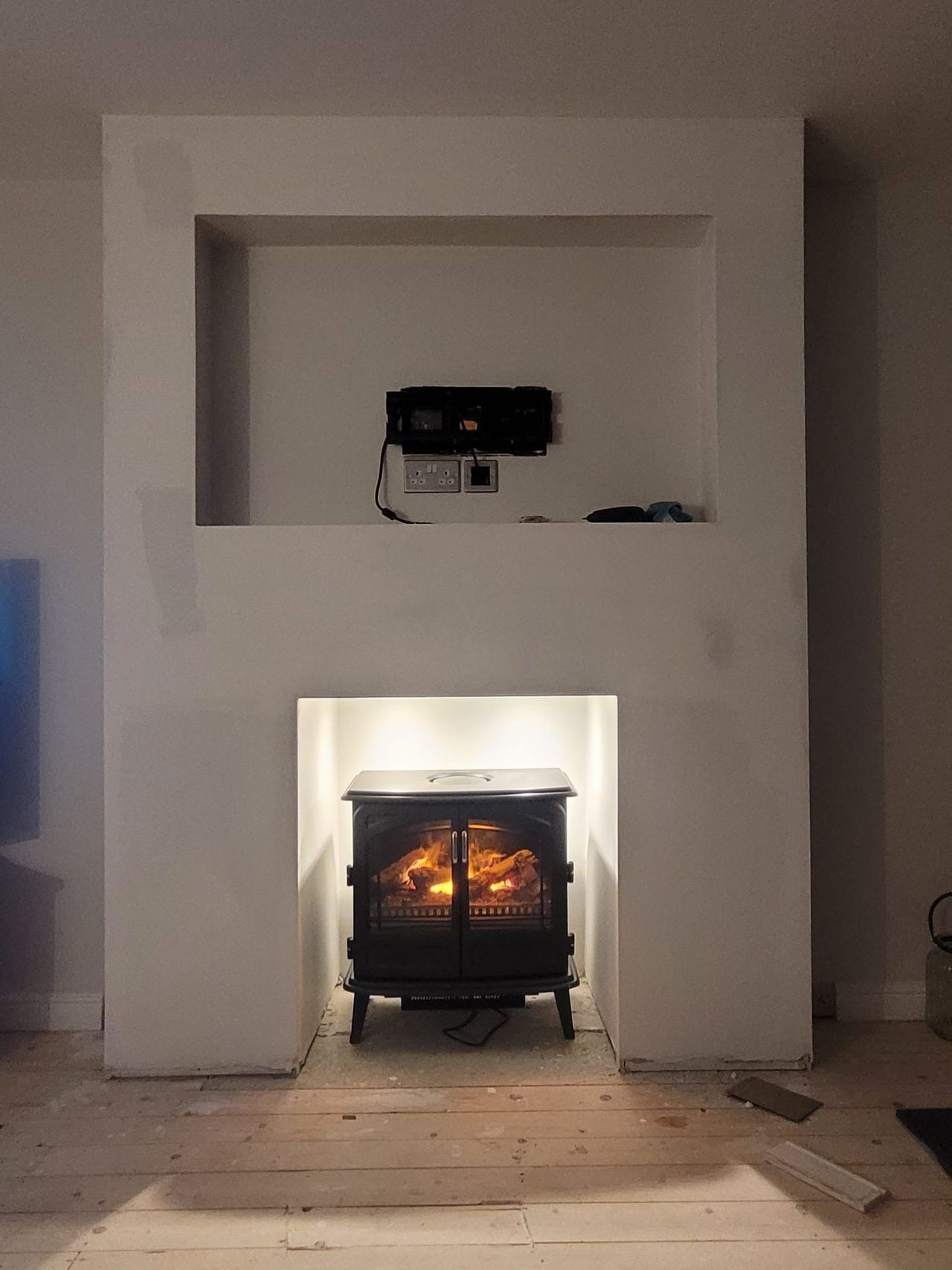
This media wall replaced an old fireplace surround on a chimney breast. We framed the new wall in timber around a stove-style fire, with a recess above for the TV and its sockets, then it was boarded, plastered and painted.
-
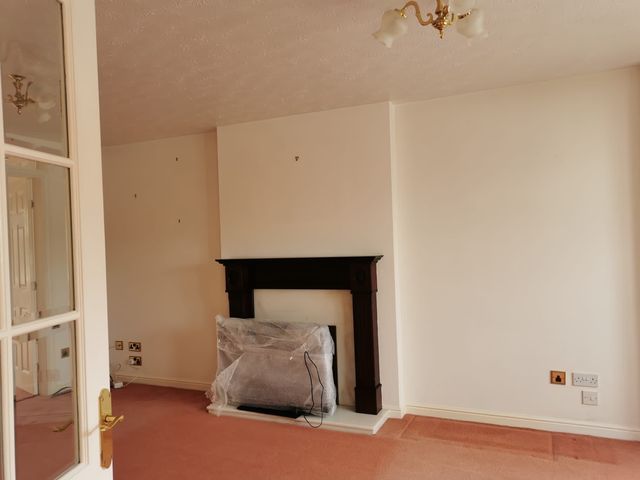
Before
The old fireplace surround -
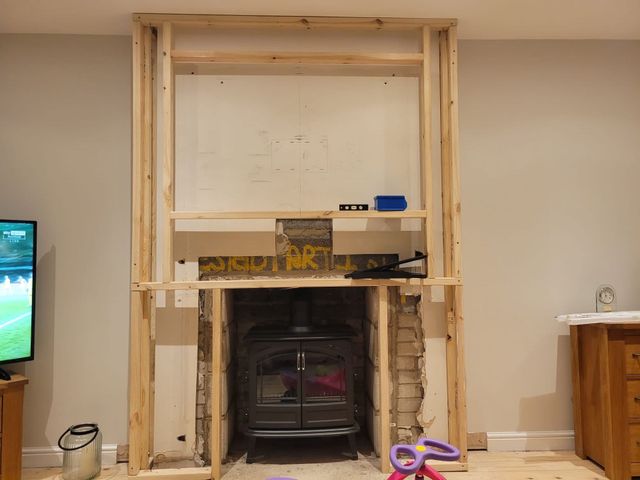
Step 1
The stud frame goes up -
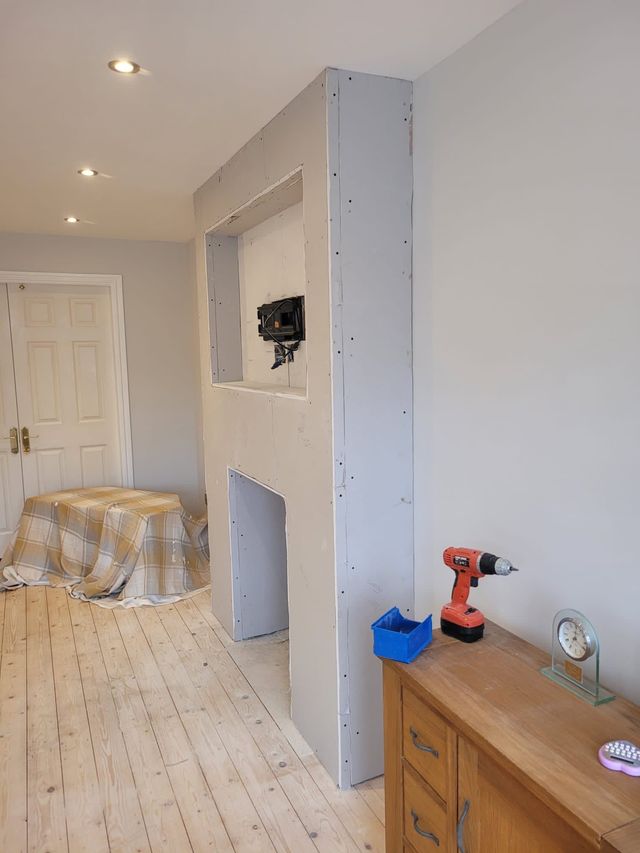
Step 2
Boarded, recesses formed -
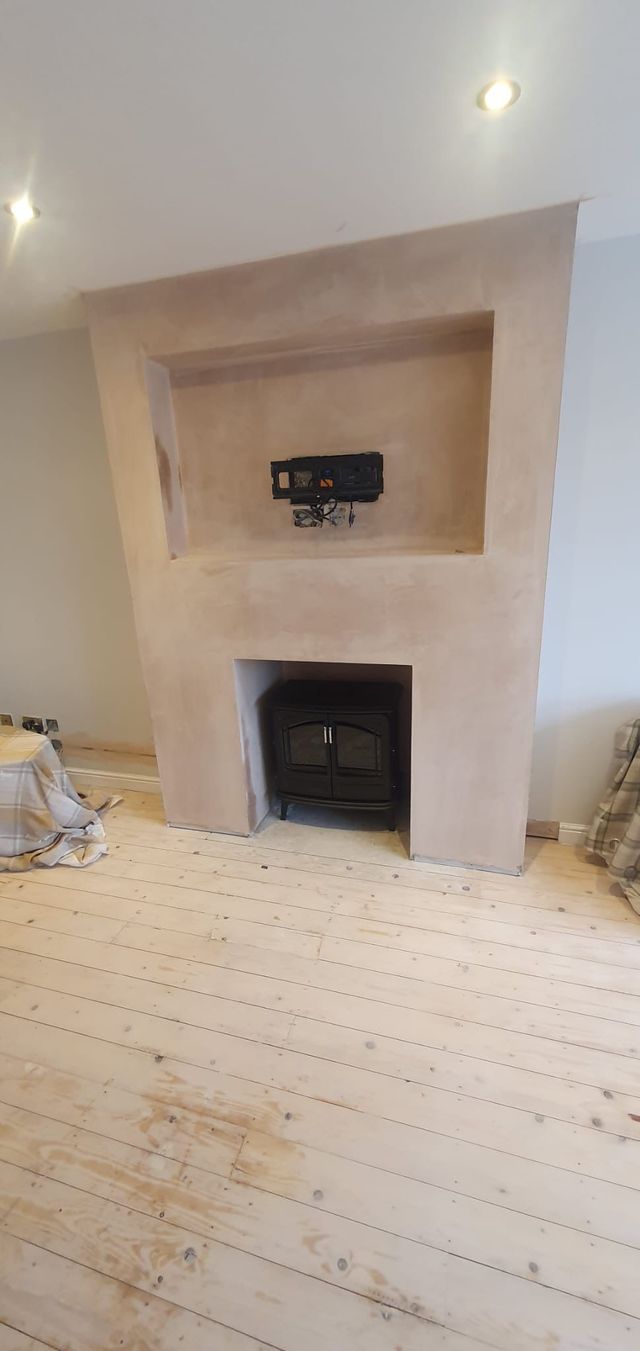
Step 3
Plastered and drying -
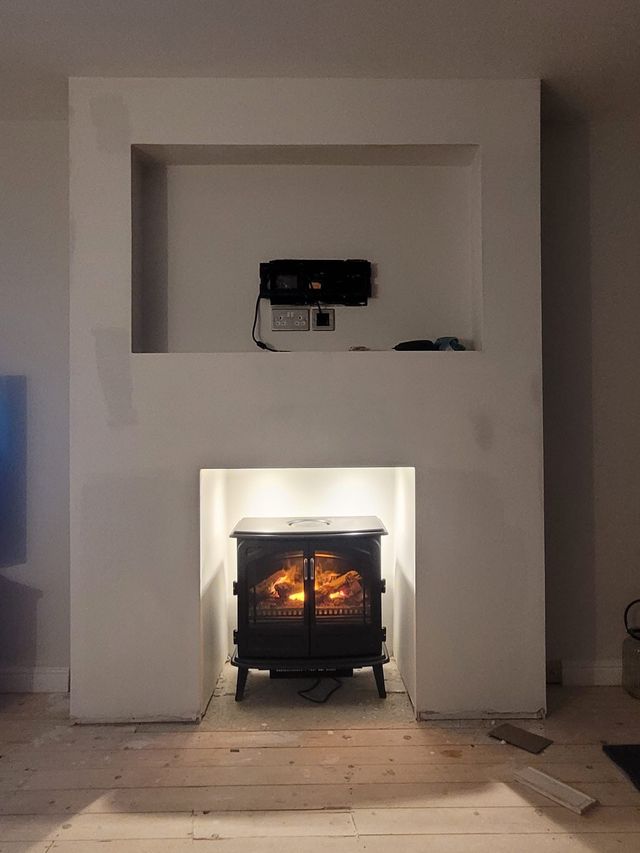
Finished
Painted, with the fire lit
Built-in or slatted: two styles of media wall
Liam Taylor, who founded Derbyshire Specialists Group, shows two media walls from one of the group’s whole-house renovations in Derby. The first is a built-in wall in the lounge, with lit alcove shelving either side of the TV. The second is a slatted wall with an inset fire in the extension.
Liam prefers the slatted style because it stays close to the wall and doesn’t take space out of the room. The built-in style gives you more storage and display space. Which suits you depends on the size of the room and how much you want on show.
Read what Liam says in the video
So media walls, they are a statement piece within a home. They can either look like this. Let’s go to the other one. Or they can look like this. I prefer these ones because they don’t come out the wall and they don’t take up loads of area.
Planning a media wall? We will look at the room and send a written quote for a wall built to fit it.
Planning your media wall
-
The fire
Electric fires are the usual choice because they need no flue and little clearance. A gas fire has to be fitted by a Gas Safe registered engineer, and the wall must be built to the manufacturer’s clearances.
-
The TV
We plan the recess or mounting point around the size of the screen and your seating, so the screen sits at a comfortable height rather than high above the fire.
-
Cables and sockets
Sockets, aerial and data cables are run inside the wall before it is boarded. Electrical work is done by a partner electrician from Derbyshire Specialists Group.
-
Depth
A built-in wall with recesses comes further into the room than a slatted or flat wall. In a smaller lounge, a slimmer design keeps more floor space.
-
Lighting
LED strips in shelves and recesses make a feature of the wall in the evening and light the room without a ceiling light.
-
Storage
Cupboards for consoles and boxes, and shelves for books and display, can be built in either side of the screen.
Built-in shelving and bespoke media units
If you would rather have storage than a false wall, we build media units and shelving to fit the room: alcove cupboards either side of a chimney breast, a run of shelves around the TV, or a full wall of shelving like the one shown here.
This one runs floor to ceiling, with tongue-and-groove backs, LED strip lighting under each shelf, cupboards along the base, a recess around the radiator and a rolling library ladder to reach the top rows.
We build fitted wardrobes and bespoke storage for the rest of the house too.
-
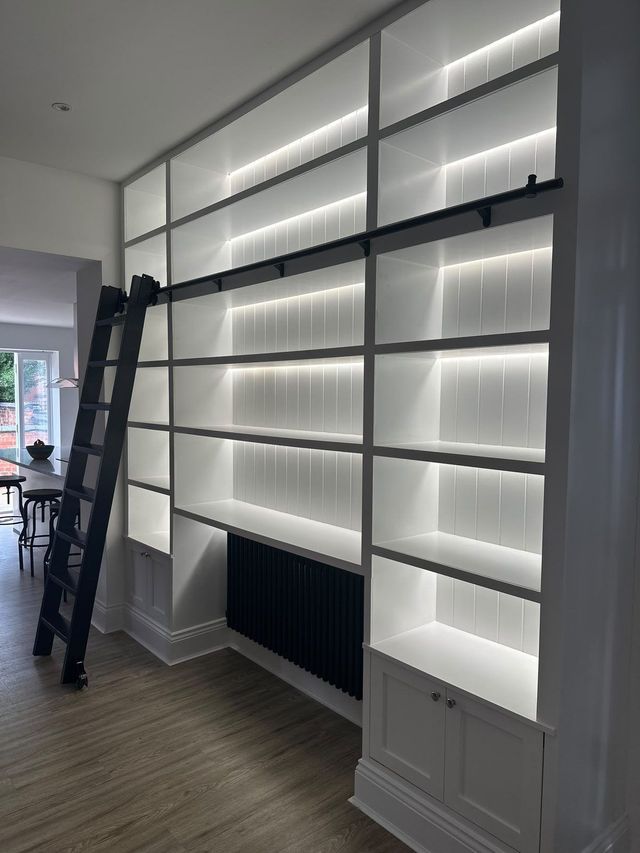
Lit shelves around the radiator -
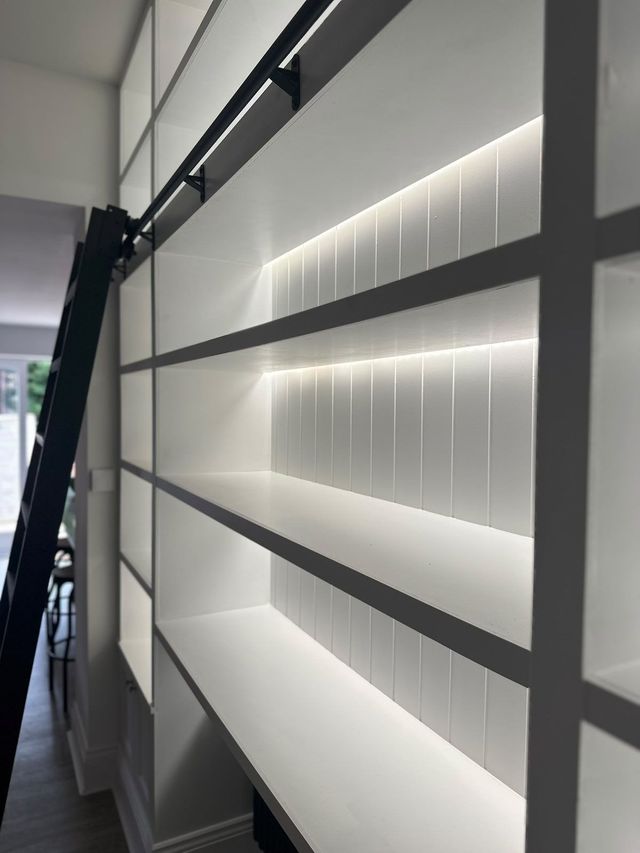
Tongue-and-groove backs and LED strips
Stud partition walls
Stud walls divide a large room, create a new bedroom, en suite or utility, or close off an opening. We set out the wall, fix the sole plate to the floor and the head plate to the ceiling directly above it, then cut and fix each stud individually, because in older houses the gap between floor and ceiling is rarely the same along the length of the wall. Noggins are fixed between the studs to stiffen the wall and give solid fixings.
Standard partitions are built in 75 mm by 50 mm or 100 mm by 50 mm timber, with the deeper studs used where the wall needs to carry more or perform better acoustically. Once the frame is up, the electrician and plumber run their services through it and the plasterer boards and skims it. We arrange those trades through Derbyshire Specialists Group, so you have one point of contact.
-
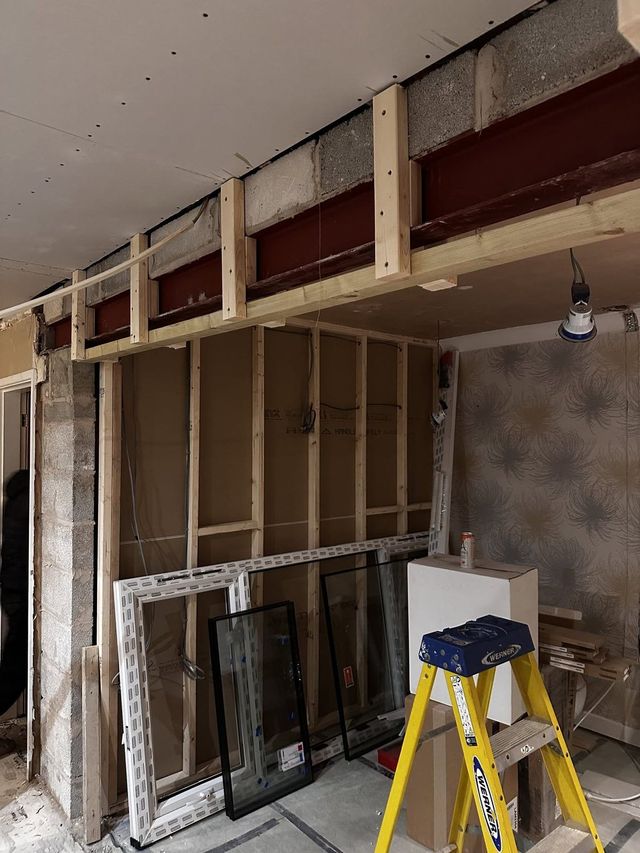
New stud framing below a steel beam -
We also frame the new walls and boxing that go with structural work, such as the opening and stud walls below a new steel beam in the photo here, ready for the plasterer.
Pattressing for TVs and heavy fixings
Plasterboard alone is not strong enough for a heavy TV, a large mirror, wall cupboards or a door closer. Pattressing means fixing plywood or OSB between the studs before the wall is boarded, so the weight is spread and the fixings bite into timber. Tell us at the survey where heavy items will go, and we will pattress just those areas rather than the whole wall.
Acoustic walls and slatted panels
The most effective way to cut noise from next door in a terrace or semi is to build a new wall in front of the party wall, with a small gap so the two do not touch. Filled with acoustic insulation and lined with sound-resistant plasterboard, it stops much more sound than adding anything to the existing wall.
Acoustic slat panels are different: they soften echo and make a room sound better, but on their own they do little to stop sound passing through a wall. We will tell you which approach suits the problem you have.
-
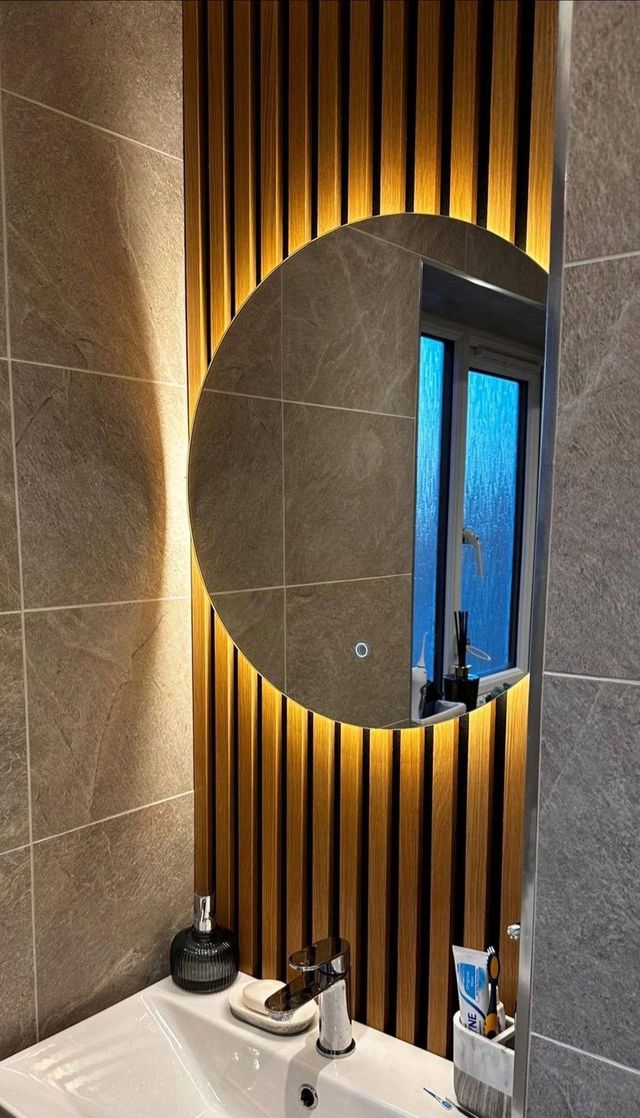
Slatted panels behind a backlit mirror -
Slatted panels are also used as a finish in their own right, behind a TV, a bed or, as here, a bathroom mirror. Fitted on battens, they can hide cables and lighting behind them.
Derbyshire Joinery Specialists is part of Derbyshire Specialists Group, founded by Liam Taylor, who has more than ten years in property and joinery.
Media wall and stud wall questions
How much does a media wall cost?
Every media wall is different, so we price each one after seeing the room. The size of the wall, the fire, the finish and any cupboards, shelving or lighting all affect the cost. We give a free written quote, and finance is available through Ideal4Finance, subject to status.
Can I have a gas fire in a media wall?
Electric fires are the usual choice, because they need no flue and little clearance. A gas fire is possible, but it must be fitted by a Gas Safe registered engineer and the wall built to the manufacturer’s clearances.
Will a stud wall hold a heavy TV?
Yes, if it is pattressed. We fix plywood or OSB between the studs where the TV will go before the wall is boarded, so the bracket is fixed into solid timber.
How long does it take to build a stud wall?
For a standard-height room, we would normally expect a partition of around 5 metres to be framed, with noggins and a couple of pattressed sections, within a day.
Do you board and plaster the wall?
We build the frame. The boarding and plastering are done by a plasterer, and any wiring or plumbing by an electrician or plumber, all arranged through Derbyshire Specialists Group.
How thick is a stud wall?
Standard partitions use 75 mm by 50 mm or 100 mm by 50 mm timber. The deeper studs are used where the wall needs to be stronger or to perform better acoustically.
Areas we cover
Media walls across Derby and Derbyshire
We build media walls and stud walls in Derby and across the towns we cover, including:
- Derby
- Belper
- Ilkeston
- Heanor
- Ashbourne
- Ripley
- Borrowash
- Castle Donington
- Melbourne
- Alfreton
- Somercotes
- South Normanton
- Allestree
- Quarndon
- Chesterfield
Areas
Our full range of services
Talk to us about a media wall
Call 01332 215505, Monday to Saturday from 7:30am to 6pm. We will look at the room, talk through the fire, the TV and the storage, and send a written quote.
